Psychedelic Somatic Interactional Psychotherapy · PSIP
Psychedelic Somatic Therapy
Psychedelic Somatic Interactional Psychotherapy is a legal, body-centered, medicine-assisted therapy to excavate and reprocess stored trauma and bring about healing at the nervous system level.
Using low dose psychedelics (cannabis and ketamine), we explore the unwinding of old narratives and patterns through the use of somatic therapy. The body stores memories, patterns, traumatic experiences, and relational wounding that overlays itself onto our present moment experiences. We often think we have an objective view of reality, yet the repeating patterns in our lives and relationships say otherwise. Our past experiences often color our present relationships without our conscious awareness, and a majority of the time, without our consent.
If you find yourself ending up in the same relationship over and over, or recreating old patterns in your long term relationships despite years in therapy, it’s likely healing on a nervous system level is required. This work speaks to the inner child, the inner infant whose needs weren’t met with as much love and care as you deserve, and whose essence is influencing your adult behaviors.
Low dose psychedelics help us to work directly with the primary consciousness (inner child/lizard brain/trauma response) without the thinking mind getting in the way quite as much.
Over time, you’ve developed management strategies that have kept you alive and safe in relationships that may have not been as safe as you needed them to be. When we pause or inhibit your management strategies, unresolved patterns and wounding come forth. Using the container of whole and healthy therapeutic relationship, we revisit past wounding within the bounds of healthy attachment so that the wounds can be excavated and reprocessed with care.
Explore PSIP · Interest FormTrauma Healing at the Nervous System Level · PSIP in Frederick, Maryland
If you’ve found your way here, something in you is likely ready for a deeper layer of healing.
You’ve probably been in therapy, have self-awareness, and can trace the origin story of your relational patterns. Despite your awareness, you still may find yourself in the same arguments, experiencing the same shutting down, or lost in the same discomfort and confusion in relationships.
You know your patterns, and yet, here they are.
The good news is that these patterns and behaviors actually indicate that your nervous system is highly intelligent. You’ve learned adaptations over time to keep you safe and alive in challenging and even traumatic situations, and your body has learned how to protect you. However, the protective mechanisms your system uses to keep you safe during a traumatic event often don’t necessarily fit the healthy present-moment relationships you want to have.
Trauma doesn’t live in your logical brain; it lives in the body and in your nervous system.
You may notice it in a freeze response when someone raises their voice, or in the relationship dynamics you keep finding yourself in despite wanting to make a different choice. Healing at that layer requires more than talking about it logically, which is where somatic work comes in.
Most therapeutic modalities are top-down, meaning that they move from the cognitive mind down into the body. PSIP is bottom-up, starting with the nervous system.
PSIP trusts the body's wisdom in the healing process, inviting healing from the inside out.
What is PSIP and is it right for you?
Psychedelic Somatic Interactional Psychotherapy (PSIP) is a body-centered, medicine-assisted therapy model developed by the Psychedelic Somatic Institute. It pairs low-dose psychedelics (ketamine or cannabis) with somatic psychotherapy and a highly relational, interactive therapeutic presence to help access and heal trauma stored in the nervous system.
PSIP is particularly well-suited for PTSD, C-PTSD, and complex or developmental trauma, especially when traditional therapy has helped you understand your patterns intellectually, but the body hasn’t caught up yet.
At Mind Body Wellness in Frederick, Maryland, we also offer Ketamine Assisted Psychotherapy (KAP), a different modality with a different focus. Both are powerful, but they’re not the same thing, and they’re right for different people at different moments.
Here’s an explanation of KAP and PSIP, and their applications:
| Ketamine Assisted Psychotherapy (KAP) | Psychedelic Somatic Interactional Psychotherapy (PSIP) | |
|---|---|---|
| Best for | Getting unstuck, treatment resistant depression, generalized anxiety, insight, inner guidance and neuroplasticity for lasting change, depression, anxiety, OCD, thought rigidity, personal growth, and anyone curious about psychedelic healing. | PTSD, C-PTSD, attachment wounds, trauma stored in the body, repeating relational patterns. PTSD, C-PTSD, complex or developmental trauma, chronic pain linked to trauma, dissociation, and people who feel stuck despite years of therapy. |
| Goal | Shift stuck patterns, overcome rumination, access your inner voice, change the way you think and cultivate a more stable foundation. | Excavate and reprocess trauma at the nervous system level to create lasting change in how you respond, not just how you think. |
| Interaction | The medicine supports a self-directed, inward journey. Your therapist holds the container, reflecting the wisdom your inner voice already knows. | Your therapist is an active, interactive participant the entire time: tracking your body, nervous system, and what arises in the relational field. |
| Experience | Sessions are an inward experience that can include profound insights, expanded perspective, and a deepened relationship with yourself. | Sessions involve somatic processing; You may shake, cry, move, or dissociate. Memories may resurface as they are reprocessed. The body leads; our role is to be a loving witness to what arises. |
| Intensity | Generally sessions are gentle, introspective, soft, and relatively mellow within the body. | As we invite primary consciousness forward, sessions may feel challenging, disruptive, or intense. |
| Container | Structured in clear way, each session includes prep, medicine, and integration. See KAP FAQ for more. | Highly variable, typically with a longer arc than KAP as the therapeutic relationship is essential and foundational to the efficacy of the work. |
Not sure which path is the best fit?
Complete the interest form and we can explore the question in your initial consultation.
PSIP Interest FormIf Trauma Patterns Keep Repeating
Most people who find their way to this work are highly self-aware and have spent a good amount of time in therapy. You likely understand intellectually (and can describe in detail) where your behavior patterns in relationships come from, and yet, understanding feels like only one piece of the whole.
Maybe you recognize yourself in some of these:
- You keep finding yourself in the same relationship dynamics, even when you know what you want to do differently
- Conflict affects you in ways that feel out of proportion, and reactions you can't understand or explain
- Your nervous system is often scanning, bracing, waiting for something that isn’t actually there (fight or flight mode is activated)
- You experience chronic tension, pain, or fatigue that doesn’t have a clear physical cause
- You’re aware of cycles within your family of origin; generational patterns that you don’t want to continue or pass on
- You feel stuck in maladaptive patterns (behavioral or relational) that self-awareness alone hasn’t been able to shift
Why Trauma Stays in the Body
The reason talk therapy has taken you only so far is not that you haven’t worked hard enough. It’s that trauma doesn’t only live in the logical thinking mind. It lives in the body and in your nervous system, held there long after you’ve made cognitive sense of what happened.
In the natural world, when animals experience a traumatic event, they have an inherent somatic process for integrating their experiences. You may have seen videos of animals who physically shake themselves after a fearful moment in order to move through it.
Humans often do it differently. Because our world doesn't always know what to do with grief and trauma, we’re usually taught to do our best to move on and seem okay even when we're not. We lack safe spaces to really process our challenges.
Rather than allowing ourselves to shake and move and physically process our emotions and the things that happen to us, we shove it all down where it can harden and turn into deeper pain, resentment, and even disease. When we don't allow our emotions to move, we can end up cut off from our bodies altogether, unconsciously repeating the trauma patterns stored in them.
PSIP to Help Break the Cycle
People who come to this work are often highly self-aware and have been in therapy before. Despite the therapeutic work you’ve done so far, you may still find yourself saying things like:
“I can’t keep living like this. I’m sick of my trauma running my life.”
“My relationships are suffering.”
“I see this pattern that lives in me, and feel like it isn’t mine.”
“I know what happened to me in the past, but I don’t want it influencing the present.”
“I want to have a choice. I’m aware of the patterns, but still feel stuck.”
“It seems like there is a layer I can’t get to by just talking about it - like the body is the missing piece.”
If you’ve said any version of these things to yourself, to a therapist, to a friend, there is nothing wrong with you.
You may just need a different kind of work.
How the Body Encodes Trauma - Somatic States
Trauma research has consistently shown that traumatic experiences are encoded not just as memories, but as somatic states. This finding, presented by Bessel van der Kolk in The Body Keeps the Score, has held up across three decades of research.
These memories are stored in the nervous system as patterns of tension, reactivity, and survival response; this is why you can understand your behavior retroactively, yet still find yourself hijacked by it in the moment.
The body holds what the mind can’t fully process. Because it does, healing often requires working at that level directly.
Primary consciousness is the pre-verbal layer of the nervous system: the inner child, the survival brain, the part that carries the trauma response. It has no sense of past or future, which is why the body can react to something happening now as though it were happening then.
PSIP works with the innate intelligence of your autonomic nervous system to help the body access and metabolize stored trauma patterns that talking alone often can’t reach. This enables us to gain access to the primary consciousness still holding the trauma.
Working with medicine (low-dose cannabis and/or ketamine) softens the default mode network (typical way of viewing the world, defense mechanisms, etc) just enough to gain access to the deep memory systems, the inner child or infant, where attachment wounds are encoded and what drives survival. This access opens while keeping one foot in secondary consciousness: your adult self and ability to have higher-level thinking)
This allows us to witness the truth of what your nervous system is holding, so it can be processed through and completed rather than bypassed or forced through.
PSIP Interest FormPSIP Rates & Session Structure
Rates are $160 / hour for all session types. We accept insurance in some cases; superbills are available upon request.
Preparation
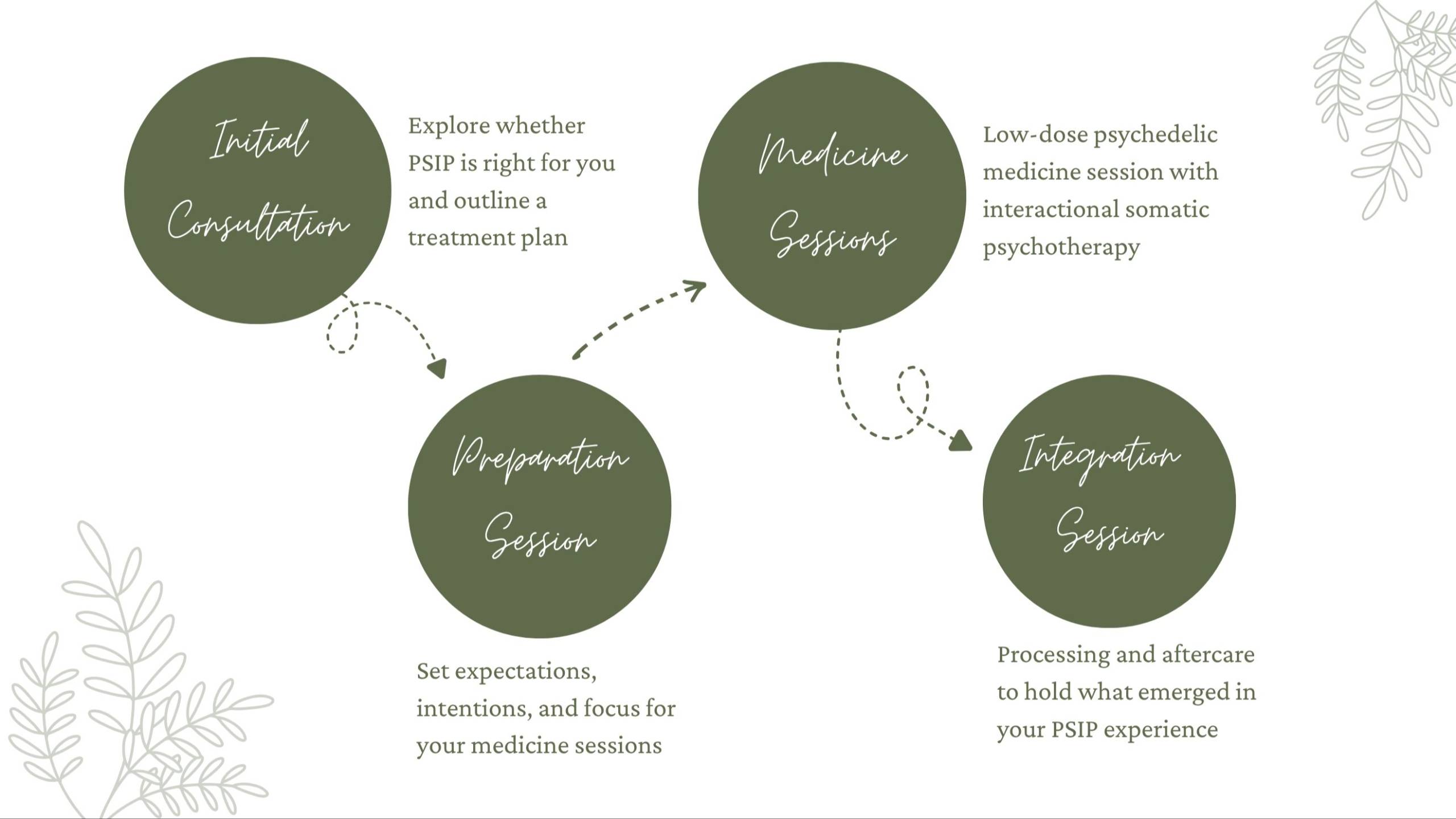
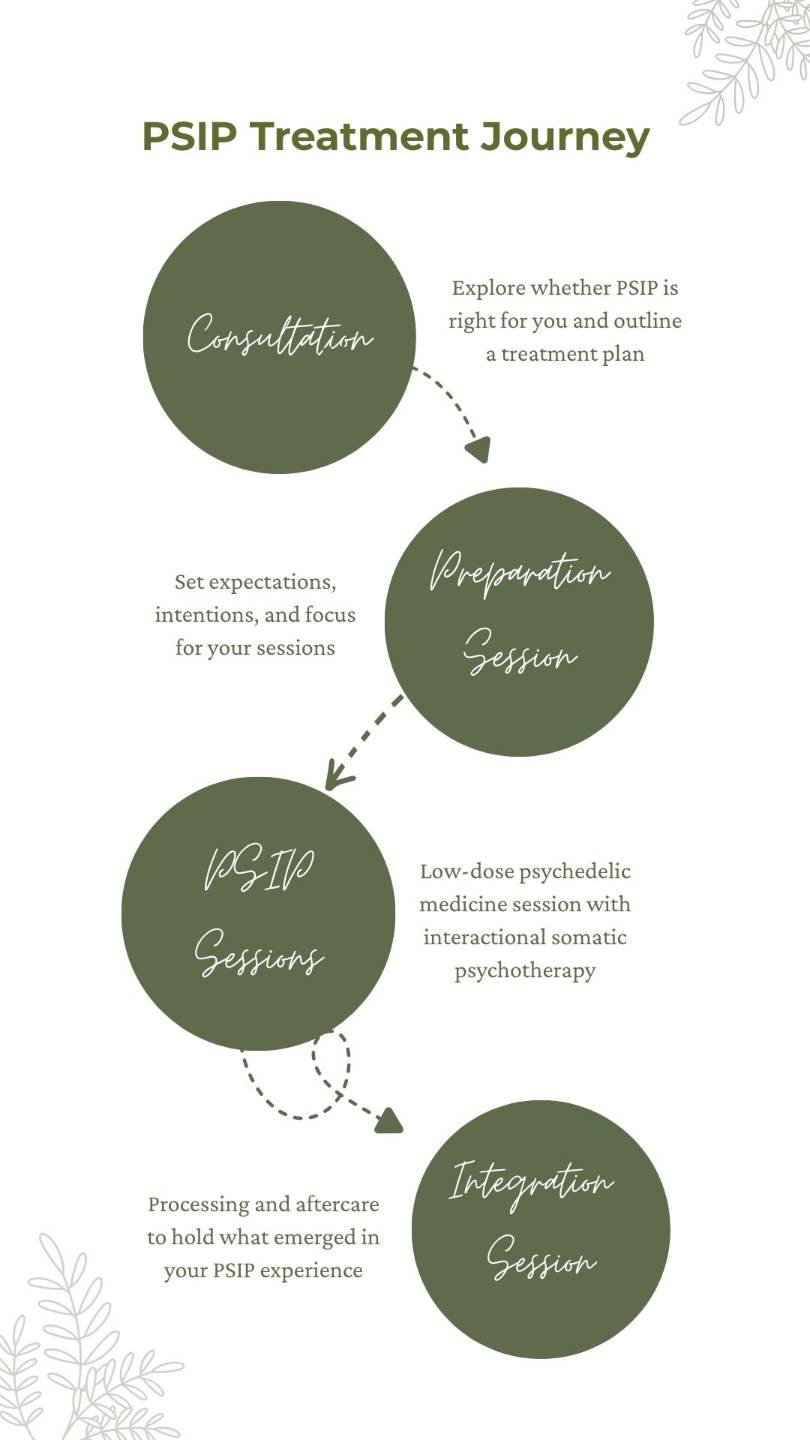
Before any medicine sessions, we spend time getting to know each other and understanding your nervous system. We spend plenty of time exploring the model, answering your questions, and preparing you for what to expect. You’ll also engage in several somatic sessions without medicine so that you can get a feel for the principles of PSIP in practice. Some people need more preparation than others, and we move at a pace that feels right for you.
Preparation sessions are 1 hour and can be done virtually.
PSIP Sessions
Using selective inhibition, we inhibit your body’s learned management strategies in order to invite the primary consciousness forward. When you dial back or stop managing, the body can show you what it has been holding onto. Our job here is to be loving witnesses to what arises so the material can be processed in a safe, held container.
Sessions are 2 to 2.5 hours and are conducted in person in Frederick, Maryland. PSIP sessions are in person only.
Integration
Throughout this process, we meet regularly without medicine to help the material land. This work can be intense and sometimes dysregulating, and integration sessions help to provide much-needed support as you navigate healing. Ongoing integration support allows you to bring what emerges during these sessions into your everyday life and relationships.
Integration sessions are 1 hour and can be done virtually.
Ongoing or Intensive Sessions
Ongoing PSIP
Sessions are paced to what feels accessible and appropriate for you. This is the right fit for most people, especially those integrating deep or complex material over time, or who want to continue the work alongside other life commitments.
PSIP Intensive
One week dedicated entirely to you. Two to four sessions back-to-back, allowing for a continuation of the work in a condensed period of time. Well-suited for people who are traveling to Frederick for this work, or who want to do concentrated deep healing in a shorter window.
Intensives are best planned ahead due to availability. Please reach out to explore scheduling options.
PSIP Treatment Journey
About Nicole Sparrow, LCPC · Founder, Mind Body Wellness
Licensed Clinical Professional Counselor, MD · Licensed Professional Counselor, VA Reiki Master Teacher · Yoga & Meditation Teacher

My name is Nicole (she/her) and I am a psychedelic facilitator, psychedelic somatic practitioner, licensed therapist, and founder of Mind Body Wellness in Frederick, Maryland.
I offer a holistic, down-to-earth, approachable lens to therapy that holds space for you to grow and heal in a safe, collaborative container.
Facilitating psychedelic-assisted psychotherapy since 2023, my interest in psychedelics has grown from a curiosity to a passion as I witness the profound healing that can occur in connection with psychedelics and plant medicine.
My work focuses on nervous system-level healing; I trust the body's wisdom to guide us in our work together. You are the expert on your own experience, and my role is to approach with loving curiosity to help you identify and unwind the adaptive (but no longer helpful) patterns within your nervous system.
I am committed to my own healing and expanding my capacity so that I can more effectively and wholeheartedly hold space for others, and also passionate about supporting other practitioners in psychedelic work. Holding space for others is a gift, and a sacred responsibility. In order to do the work that you're meant to do in the world, you also need space for your own personal care and growth.
Nicole is currently accepting new clients for Ketamine Assisted Psychotherapy, Psychedelic Somatic Therapy, and psychedelic integration sessions.
Work with NicoleQualifications & Education
Psychedelic Somatic Interactional Psychotherapy (PSIP) Certificate | Psychedelic Somatic Institute →
M.S. Counseling & Advanced Graduate Studies, Clinical Mental Health Counseling | Johns Hopkins University
Psychedelic-Assisted Therapy, Ketamine Apprenticeship Training, MDMA-Assisted Therapy | Naropa University →
Clinical Trauma Professional Certificate CCTP & EFT Training | PESI
Inside Sessions: What PSIP Looks Like
PSIP is a highly interactive, deeply relational process; one in which the therapist is an active participant the entire time. I’ll be tracking your body movements, your nervous system, and the relational dynamics arising in session.
By selectively inhibiting your learned management strategies, PSIP helps you enter primary consciousness to allow unresolved trauma to complete. The body reveals and works toward resolving unfinished survival responses (fight, flight, freeze, fawn).
Over time, you’ve learned management strategies that have kept you alive and safe in relationships, especially ones that weren’t as safe as you needed them to be. When we slow down and gently pause those strategies, unresolved patterns come forth.
You may shake, cry, move, or dissociate. The point isn’t to control the process. It’s to witness what your body is holding onto without managing it, so that the material can be processed. This work tends to the inner child or infant whose needs weren’t met with as much love and care as you deserved, and whose essence may still be influencing your adult behaviors.
Within the container of a whole and healthy therapeutic relationship, we revisit past wounding to excavate and reprocess it with care.
Setting Honest Expectations
This is hard work, and sessions can be dysregulating. Re-experiencing painful material is challenging, and the days after a session can be tender as the material integrates. The preparation period exists so that you can feel ready before we begin. Your autonomy and choice are centered as we build the container together.
What Becomes Possible with PSIP
PSIP isn’t only about reducing symptoms. It’s a fundamental restructuring of how your nervous system responds, how you show up in relationships, and how you experience yourself and the world around you. For many people, what shifts is something they couldn’t quite articulate before: their freedom and choice to respond in a new way, and more capacity to authentically be present in their own life.
Some of the common benefits noted by clients:
- Choice in how you respond, especially when conflict or discomfort arises
- More objective view of reality, less colored by past experiences and old wounds
- Stronger, healthier relationships; less reactivity, more genuine presence
- Clearer sense of who you are without the old patterns of behavior
- Freedom and authenticity in your being
For me, the heart of this work is about helping people have more choice. When we release trauma and protective patterns from the body and nervous system, we can choose to respond rather than react.
If you’re ready to take the next step towards exploring PSIP, complete the form below.
Complete the interest formPsychedelic Therapy at Mind Body Wellness
Affirming, Inclusive and Collaborative Care
At Mind Body Wellness, we whole-heartedly believe in collaborative care. We have providers who specialise in a variety of modalities including EMDR, art therapy, trauma, couples therapy, and psychedelic integration. If you’re already working with a therapist and want to explore PSIP, I’m happy to coordinate with them to support your care.
Mind Body Wellness is a trauma-informed space open to all ethnicities, races, cultural identities, gender identities and expressions, religions and spiritual practices, and sexual orientations. We are committed to being a LGBTQIA+ celebrating, neuro-affirming, and anti-racist space.
Psychedelic Medicine: Our Approach
We offer acknowledgement and deep reverence to indigenous peoples who were the original stewards of psychedelic medicine and medicine work. While ketamine is a human-made compound, keepers of plant medicine have been partnering with altered states of consciousness through the use of psychedelics for thousands of years before us. Without their wisdom, we would not have the means to offer this modality as a path for healing.
Frequently Asked Questions
Is PSIP safe?
What if it brings up things that are hard to manage afterwards?
I’ve tried therapy before and it didn’t fully work. Why would this be different?
What if I already have a therapist?
Is PSIP available in Maryland?
Can I drive after my treatment?
What does PSIP cost?
Do you accept insurance?
What if I am not a Maryland resident?
What kind of support do I need after a session?
How do I know if I’m ready for PSIP?
PSIP Resources
Podcasts
Somatic & Relational Psychedelic Therapy: A New Era in Mental Health — Deconstruction podcast. Saj Razvi, founder of PSI, on how PSIP addresses relational wounding and attachment repair in psychedelic states. Listen on Spotify →
Psychedelic Somatic Therapy with Saj Razvi — Back from the Abyss: Psychiatry in Stories. An actual audio recording of a ketamine PSIP session, with Saj walking through transference and nervous system resolution in real time. Listen on Spotify →
Craig and Saj Razvi Talk Shop — Back from the Abyss. A deeper conversation on dissociation, the unconscious, and what PSIP addresses that other approaches often miss. Listen on Spotify →
Psychedelic curious? Let's stay connected!
Enter your info below to stay up to date on psychedelic happenings at Mind Body Wellness.
